Effect of New Healthy and Viable Food Supplement on the Inhibition of Apoptosis and Increase of Neural Stem Cell Proliferation and Acute Toxicity of the Studied Diet in Rats
Azam Bayat*, Aref Khalkhali and Ali Reza Mahjoub
Published Date: 2025-04-05DOI10.36648/2472-1921.11.2.187
Azam Bayat1*, Aref Khalkhali2 and Ali Reza Mahjoub3
1Department of Chemistry, Tarbiat Modares University, Tehran, Iran
2NBS Organic Company, Istanbul, Turkey
- *Corresponding Author:
- Azam Bayat Department of Chemistry, Tarbiat Modares University, Tehran, Iran E-mail:azam.bayat@modares.ac.ir
Received date: September 07, 2024, Manuscript No. IPJCND-24-19599; Editor assigned date: September 10, 2024, PreQC No. IPJCND-24-19599 (PQ); Reviewed date: September 24, 2024, QC No. IPJCND-24-19599; Revised date: April 29, 2025, Manuscript No. IPJCND-24-19599 (R); Published date: April 05, 2025, DOI: 10.36648/2472-1921.11.2.187
Citation: Bayat A, Khalkhali A, Mahjoub AR (2025) Effect of New Healthy and Viable Food Supplement on the Inhibition of Apoptosis and Increase of Neural Stem Cell Proliferation and Acute Toxicity of the Studied Diet in Rats. J Clin Nutr Diet Vol:11 No:2
Abstract
Objective: The aim of this study was to evaluate the effect of a new healthy and viable food supplement on the inhibition of apoptosis and increase of neural stem cell proliferation and acute toxicity of the studied diet in rats.
Methods: New healthy and viable food supplement were synthesized by a green route. This organic biomaterial was named NBS. Colorimetric assay for measuring the activity of enzymes (MTT) was used to assay cell proliferation and Terminal deoxynucleotidyl transferase dUTP Nick End Labeling (TUNEL) assay to inhibit neural stem cell apoptosis. Wistar rats were also used to assay acute cytotoxicity. The mice were divided into three groups for treatment with food supplements and one group with 5 mice as control. Treatment groups were treated with the new healthy and live food supplement at concentrations of 500, 1000 and 1500 mg/kg for 28 days.
Results: The results of this study showed that concentration of 800 μg/ml was considered as the best concentration. The results of anti-apoptotic activity of extract showed that using healthy food supplement caused significant decrease in apoptosis in the healthy and live food supplement group compared to the control group. The results of acute toxicity analysis showed no increase or decrease in biochemical, hematological and pathological parameters in the studied animals. No specific macroscopic or microscopic signs of toxicity were observedand none of the mice studied in this research were killed during the study period.
Conclusion: The results showed that the new healthy and viable food supplement increases life expectancy.
Keywords
Healthy and alive food supplement; Acute toxicity; Proliferation; Apoptosis; Cell survival
Introduction
The most common site of neural stem cells is in the subcutaneous regions [1]. Neural stem cells are able to differentiate into most specialized brain cells and are able to migrate to damaged sites and participate in repair [2]. Stem cells in the subcutaneous regions can be activated in response to pathological signals such as trichrome, ischemia, inflammationand neurodegeneration and myelin depletion [3]. These cells can partially shift from their natural pathway to the injury site and become a specific cellular phenotype in the injury site [4]. There are no naturally occurring family of neurotransmitters and mediators of neurogenesis in the nervous system [5]. During injury, these agents are released from the cells of the affected areas and induce division, migration, revitalization of stem cells to neuronal and glial precursor cells, as well as differentiation of precursor cells. Many other factors including hormones, neurotransmittersand inflammatory matrix extracellular factors can be involved in the regulation, proliferation, regeneration, migration and differentiation of precursors. One of the most important issues in cellulite is the use of an appropriate stimulus to increase the rate of proliferation of neural stem cells in vitro. Today, life expectancy has been the most important goal of human and medical societies, so the study of finding drugs that increase the survival and proliferation of body cells is more important than ever before, according to the present study. The aim of this study was to evaluate the effect of a new healthy and viable food supplement on the inhibition of apoptosis and increase of neural stem cell proliferation and acute toxicity of the studied diet in rats. This healthy and viable food supplement were synthesized by a new and green route. It was named NBS. The NBS healthy and live food powder has various vitamins, macro and micro moleculesand ingredients such as B1, B2, B3, B5, B6, B9, C, K, A, E, D, phosphorus, potassium, sulfur, magnesium, calcium, boron, iron, manganese, zinc, copper, omega-3, omega-6, omega-9, and etc.
The healthy and viable medicinal supplement in the current research may be comparable to chemical supplements. The majority of the multivitamins that are available on the market only meet the needs of the human body. In addition, special attention was paid to their regulation and balance. This highlights the importance of the balanced cellular, molecular and metabolic function of the human body, which has often been overlooked in other chemical and herbal drugs. In general, emphasis on balance is associated with the improvement and treatment of various diseases.
Another example in this regard is Ganoderma fungi, which has recently been introduced as a therapeutic drug owing to its active compounds for the body, some of which require further investigation. These fungi contain some chemicals that are unknown to the body, including three types of toxins, which may be hazardous to liver health. In addition, the long-term consumption of this material at high doses could lead to adverse complications.
With this background in mind, no comparable foreign and domestic products have been registered that are produced in a similar manner to the processing of cereal grains in the form of a powder supplement for the disease control and treatment.
Materials and Methods
Preparation of food supplement
First stage: The seed genome (set of genes within the nucleus) is often better prepared for activity after winter (hibernation) or a cold shock. Induction of shock to the genome of cells to be in unfavorable conditions before creating the optimal conditions is highly effective as well. Therefore, the induction of cold shock at this stage of the genome activation process is of utmost importance. In addition, the enzymatic and hormonal system of the plant seed could be exposed to the start conditions for better preparation. At this stage, the seeds are maintained at the temperature of 0–(-5)°C for 10-12 hours (this shock is induced to the genome of cells for the simulation of unfavorable conditions).
Second stage: At this stage, proper humidity and heat shock are introduced into the genetic system of the seeds so as to provide the favorable conditions for the action of specific enzymes (e.g., nucleases and proteases). At this stage, the genetic system of the nucleus of the seeds begins to synthesize the material, activating the production of protein and vitamins. The material was preserved at the temperature of 20°C and humidity of 18-25% for 24-48 hours [6].
Third stage: At this stage, high-precision conditions must be set in order to regulate the pressure, humidity and acidity, so that the preparation would reach its peak, activating many genes. Moreover, several minerals are placed in the cellular system of the seeds as absorbable ions and biofactors, losing their non-absorbable chemical and molecular state. At this stage, many vitamins are synthesized, leading to the production of group B and ATP vitamins, which are the main sources of energy in the body. At this stage, humidity is 30-40 percent, temperature is 25°C, acidity is 8.5 and the duration is 30 hours.
Fourth stage: This stage involves placing the seeds in a conventional fan shelf dryer at the temperature of 30-35°C for 15-20 hours in order to reach the humidity of 10-15%.
Fifth stage: After drying of the seeds, they are grinded, powdered and packaged.
Isolation and culture of neural stem cells
For the isolation of neural stem cells, five neonatal Wistar rats from the Green Drug Researchers Knowledge Company were used. Mice were maintained in accordance with the protocol for working with laboratory animals. After complete anesthesia, after complete anesthesia, the hippocampus was separated from the hemisphere and after mechanically crushing twice the amount of tissue, the enzymes acutase and collagenase were used for 30 minutes at 37°C to digest the enzyme. In the next step, FBS bovine serum was used to neutralize the enzymes. The suspension was then passed through a 70 μm nylon mesh filter and centrifuged at 3000 rpm for 10 minutes. Cellular precipitation with DMEM/F12 culture medium containing 20 ng bFGF growth factor, 20 ng EGF growth factor, B27 (%), penicillinstreptomycin (1%) plus 5% FBS serum in incubator with a 37°C temperature and 5% CO2 were cultured. The cell culture medium was changed after 24 hours and continued for 5 days. A group of neural stem cells attached to the bottom of the flask and floating neurospheres were also collected from the plate by the sampler and transferred to a 15 cc Falcon and after centrifugation and pipetting, they were transferred to another plate. Then, with DMEM/F12 culture medium contains growth factor bFGF (10 ng), EGF growth factor (10 ng), B27 (1%), penicillin-streptomycin (1%) plus 5% FBS serum in incubation at 37°C and 5% CO2 was cultured. After reaching a density of 80-70%, the cells were separated from the bottom of the flask using trypsin and passaged in a ratio of 1 to 2. Third passage cells were used in this study.
Treatment of neural stem cells with a healthy live food supplement
Neonatal stem cells isolated from rat hippocampus in a control group and five groups treated with the extract in 96-well plates at concentrations of 200, 400, 600 and 800 μg/ml for 48 h. Also to evaluate the anti-apoptotic effects of the healthy and viable food supplement, neural stem cell was classified in five groups:
• The first control group (neural stem cells).
• The first test group of neural stem cells treated with 200 μg/ml of healthy and viable food supplement.
• The first test group of neural stem cells treated with 400 μg/ml of healthy live supplement.
• The first test group of neural stem cells treated with 600 μg/ml of healthy and viable food supplement.
• The first test group of neural stem cells treated with 800 μg/ml of healthy and viable food supplement.
MTT test
MTT method was used to evaluate the rate of proliferation. Initially, cell cultures were counted after trypsinization of the cells from the main flask and the cells in 5000 number of cells was transferred to 24 well plates. After 48 hours of treatment with a healthy diet supplement, the cell culture medium was replaced with 20 μl of solution (MTT sigma) at a concentration of 5 mg per ml, which was prepared fresh. After 4 h of incubation at 37°C, the solution was slowly removed from the cell and the formazasone crystals reacted with MTT in 100 μl DMSO. After a few minutes of incubation at room temperature and complete crystallization, the absorbance at 570 nm was calculated by ELISA. For more assurance, the optical absorption was repeated 3 times and the mean of three replicates was expressed as the final result [7].
Evaluation of apoptosis using TUNEL method
According to MTT results, 800 μg/ml concentration was considered as the most appropriate concentration. Therefore, this concentration was used to investigate apoptosis. The diagnostic method for apoptosis was performed according to the Kate Tanel (Roche, Germany). In summary, the culture medium of the neural stem cells was depleted after 48 hours of treatment in the study group. In this study, 10% ethanol was used to induce apoptosis. One group was treated with ethanol alone and the other group with 10% ethanol plus a concentration of 800 live and healthy food supplement. After washing 3 times with PBS, fixed with 4% paraformaldehyde solution for 30 minutes. Then blockin solution (3% H2O2 in methanol) was added to the cell for 10 min and after washing with PBS, in permeabilization solution (containing 0.1% Triton in 0.1% PBS) placed. 50 μl of reaction mixture solutions were added to the cells and incubated at 37°C for 1 hour. Then, 50 μl Converter-POD solutions were added and placed at 37°C for 30 minutes. To examine with a light microscope, 50-100 μl DABsubstrate solution was added and held for 20 min at ambient temperature. Then washed with PBS and Dab-Chromogen 20 μL was added. Samples were visualized by light microscopy and mounted on PBS and glycerol. An examination by tunnel testing revealed that apoptotic cells were visible in light brown or dark brown.
Acute toxicity check
To determine the acute toxicity of healthy and alive food supplements, Wistar rats were housed at 22 to 25°C with 12 hours of dark and 12 hours of light in special cages and animal plates. Nutrition labs and enough water were placed in their hands. For this test, mice were divided into three groups for treatment with the desired extracts and one group with 5 mice as control. Treatment groups were treated with healthy and live food supplement at concentrations of 500, 1000 and 1500 mg/kg for 28 days. During this period, animals were evaluated for motility, alertness, mortality and so on. At the end of this period, each group of mice was randomly selected and their blood and sacrifice were collected for hematological and biochemical tests. Serum glucose, urea, creatinine, albumin, globulin, ALT, AST, ALP, LDH concentrations were measured. From the liver of mice for pathological studies, incisions of 4-6 mm were prepared and stained with hematoxin eosin.
Results
Analysis of new healthy and live food supplement is S1 (not shown). Also, analysis of phenolic compounds in the nutritional supplement and healthy living (extracted with using HPLC) are shown as Figure 1. The percent of phenolic compounds of new healthy and live food supplement are arctigenin 2.34, gallic acid 2.41, quercetin 9.42, alpha linoleic acid 26.80, linoleic acid 19.46, inulin 2.64, oleic acid 13.24 and unknown compound 23.69. Meanwhile, the MTT test results were shown as Table 1 and the chart of statistical comparison of neural stem cells at different concentrations of healthy and viable food supplements were shown in Figure 2.
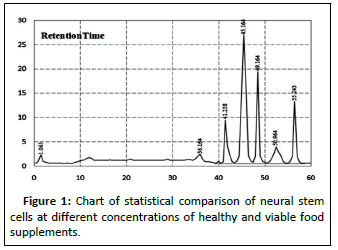
Figure 1: Chart of statistical comparison of neural stem cells at different concentrations of healthy and viable food supplements.
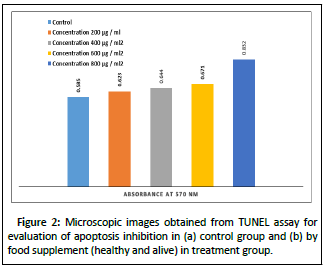
Figure 2: Microscopic images obtained from TUNEL assay for evaluation of apoptosis inhibition in (a) control group and (b) by food supplement (healthy and alive) in treatment group.
| Repeat | ||||
| Group | 1 | 2 | 3 | Average |
| Control | 0.584 | 0.581 | 0.592 | 0.585 |
| Concentration 200 µg/ml | 0.616 | 0.629 | 0.624 | 0.623 |
| Concentration 400 µg/ml | 0.644 | 0.651 | 0.637 | 0.644 |
| Concentration 600 µg/ml | 0.675 | 0.669 | 0.671 | 0.671 |
| Concentration 800 µg/ml | 0.836 | 0.829 | 0.833 | 0.832 |
Table 1: Statistical comparison of neural stem cells at different concentrations of healthy and live nutrition.
In this study, in order to evaluate the significance of the data, it is recommended to use ANOVA test. ANOVA test was used to investigate the differences between and within groups. The results of this test showed that there was a significant difference between the groups with 5% probability level. In order to clarify this issue, by Scheffe post-hoc test, this significance was tested one by one between groups (S2, not shown).
The anti-apoptotic activity of the extract showed that the use of healthy and live food supplement significantly reduced apoptosis in the healthy and live food supplement group compared to the control group. The results of this study showed that healthy and viable food supplement increase proliferation of stem cells and prevent apoptosis of neural stem cells and increases lifespan. Figure 3 shows microscopic images obtained from TUNEL assay for evaluation of apoptosis inhibition by food supplement (healthy and alive). The present image shows that the selective method of inducing apoptosis is properly performed and the use of 10% ethanol induces apoptosis [8]. Also, in this figure, microscopic image of the treatment group with a healthy diet of 800 μg/ml indicate inhibition of apoptosis compared to the control group.
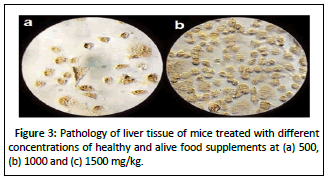
Figure 3: Pathology of liver tissue of mice treated with different concentrations of healthy and alive food supplements at (a) 500, (b) 1000 and (c) 1500 mg/kg.
Also, in acute toxicity check, none of the studied animals showed any increase or decrease in biochemical, hematological and pathological parameters compared to the control group. No macroscopic or microscopic signs of toxicity were observed and none of the mice studied in this study were killed during the study period. Pathology of liver tissue of mice treated with different concentrations of healthy and alive food supplements are shown in Figure 4. Hepatocytes and normal liver tissue structure and no changes or necrosis were observed in liver cells. Also, changes in rat biochemical and hematological parameters following consumption of different doses of healthy and alive food supplements, are listed as Tables 2 and 3, respectively.
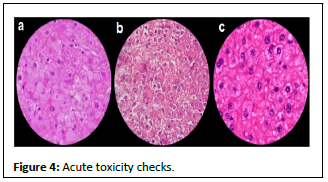
Figure 4: Acute toxicity checks.
|
Parameter |
Control groups |
Healthy and |
||
|
0 |
500 |
1000 |
1500 |
|
|
FBS mg/dl |
87 |
79 |
84 |
82 |
|
BUN mg/dl |
18 |
15 |
16 |
20 |
|
Cr g/dl |
0.9 |
0.7 |
0.7 |
0.8 |
|
Albumin g/dl |
4.7 |
4.1 |
4.6 |
4.9 |
|
Globulin IU/mL |
1.8 |
1.7 |
1.6 |
2.1 |
|
ALT U/L |
32 |
41 |
40 |
44 |
|
AST U/L |
31 |
29 |
33 |
36 |
|
ALP IU/L |
156 |
168 |
189 |
192 |
|
LDH IU/mL |
135 |
165 |
145 |
156 |
Table 2: Changes in rat biochemical parameters following consumption of different doses of healthy and alive food supplements.
| Parameter | Control groups | Healthy and alive intake group drug | ||
| 0 | 500 | 1000 | 1500 | |
| HB g/dl | 13 | 14 | 13 | 14 |
| HC % | 48 | 48 | 52 | 51 |
| WBC (Cell x 106/mm3) | 4.6 | 4.1 | 5.6 | 5.2 |
| RBC (Cell x 10³/mm³) | 4.3 | 4.2 | 4.6 | 4.1 |
| PLT (Cell x 10âÂõ/mm³) | 8.4 | 9.4 | 8.2 | 8.1 |
Table 3: Changes in rat hematological parameters following consumption of different doses of healthy and alive food supplements.
Discussion
The mechanism of programmed cell death that occurs following intracellular mechanisms, particularly fragmentation, is called apoptosis or programmed cell death. Apoptosis is a physiological and biological process for active and natural development as well as homeostasis maintenance. In cases where the survival of a cell endangers the living being, the cell commits suicide with a planned death. When the cell is affected by various environmental or even intrinsic factors such as ionizing radiation, cytotoxic drugs (in the treatment of cancers), hyperthermia, glucocorticoid hormones, etc., its subject, including DNA, undergoes changes that, if it continues severe abnormalities, lead to severe abnormalities, including cell cancer. Other factors, such as some intracellular pathogenic bacteria such as Salmonella, Shigella, Listeria, Legionella, etc. can also be effective in directing cells to this particular type of death by altering their infection in some intracellular metabolic and biochemical pathway. Programmed cell death is triggered by various pathways, some of which are triggered by the binding of ligands to cell surface receptorsand some of these pathways are triggered by the lack of some growth factors. Severe damage to the genetic material of the cell can also trigger various pathways that lead to apoptosis. Apoptosis is a physiological process of cell death that is triggered by activation of caspase-binding enzymes. The intracellular ratio of apoptosis-inducible proteins such as BAX or Bak to anti-apoptotic-like proteins (BCL_2) determines the cell's susceptibility to apoptosis. During apoptosis the cell volume decreases and numerous vesicles are formed in the cell. The chromatin is then compressed and fragmented. Subsequently, the membrane is destroyed by the nucleusand eventually the cell is divided into small vesicles in several parts [9].
Conclusion
During apoptosis, the internal organs of the cell, such as, mitochondria and lysosomes, remain intact. Vesicles arising from cell fragmentation are swallowed and digested by phagocytes. The results of this study indicate that the new NBS healthy and viable food supplement increases the proliferation of stem cells and prevents the apoptosis of neural stem cells.
Acknowledgements
The authors acknowledge finical support of NBS Organic Company and Tarbiat Modares University for supporting this work.
References
- Bonilla S, Silva A, Valdés L, Geijo E, Garcíaâ??Verdugo JM, etâ?¯al. (2005) Functional neural stem cells derived from adult bone marrow. Neuroscience 133:85–95
[Crossref] [Google Scholar] [PubMed]
- Hermann A, Gastl R, Liebau S, Popa MO, Fiedler J, etâ?¯al. (2004) Efficient generation of neural stem cellâ??like cells from adult human bone marrow stromal cells. J Cell Sci 117:4411–4422
[Crossref] [Google Scholar] [PubMed]
- Fallon J, Reid S, Kinyamu R, Opole I, Opole R, etâ?¯al. (2000) In vivo induction of massive proliferation, directed migration, and differentiation of neural cells in the adult mammalian brain. Proc Natl Acad Sci USA 97:14686–14691
[Crossref] [Google Scholar] [PubMed]
- Jin K, Sun Y, Xie L, Peel A, Mao XO, etâ?¯al. (2003) Directed migration of neuronal precursors into the ischemic cerebral cortex and striatum. Mol Cell Neurosci 24:171–189
[Crossref] [Google Scholar] [PubMed]
- Watts C, McConkey H, Anderson L, Caldwell M (2005) Anatomical perspectives on adult neural stem cells. J Anat 207:197–208
[Crossref] [Google Scholar] [PubMed]
- Lennington JB, Yang Z, Conover JC (2003) Neural stem cells and the regulation of adult neurogenesis. Reprod Biol Endocrinol 1:99
[Crossref] [Google Scholar] [PubMed]
- Srivastava JK, Shankar E, Gupta S (2010) Chamomile: A herbal medicine of the past with bright future. Mol Med Rep 3:895–901
[Crossref] [Google Scholar] [PubMed]
- Singh O, Khanam Z, Misra N, Srivastava MK (2011) Chamomile (Matricaria chamomilla L.): An overview. Pharmacogn Rev 5:82–95
- Cemek M, KaÄ?a S, SimÅ?ek N, BüyükokuroÄ?lu ME, Konuk M (2008) Antihyperglycemic and antioxidative potential of Matricaria chamomilla L. in streptozotocinâ??induced diabetic rats. J Nat Med 62:284–293.
[Crossref] [Google Scholar] [PubMed]
Open Access Journals
- Aquaculture & Veterinary Science
- Chemistry & Chemical Sciences
- Clinical Sciences
- Engineering
- General Science
- Genetics & Molecular Biology
- Health Care & Nursing
- Immunology & Microbiology
- Materials Science
- Mathematics & Physics
- Medical Sciences
- Neurology & Psychiatry
- Oncology & Cancer Science
- Pharmaceutical Sciences